Abstracts
- Length: 250–350 words
- Structure: objectives, methodology, results/conclusions, relevance for practice
- Keywords: 4–6
- Accepted languages: Romanian or English
 Registration: paper
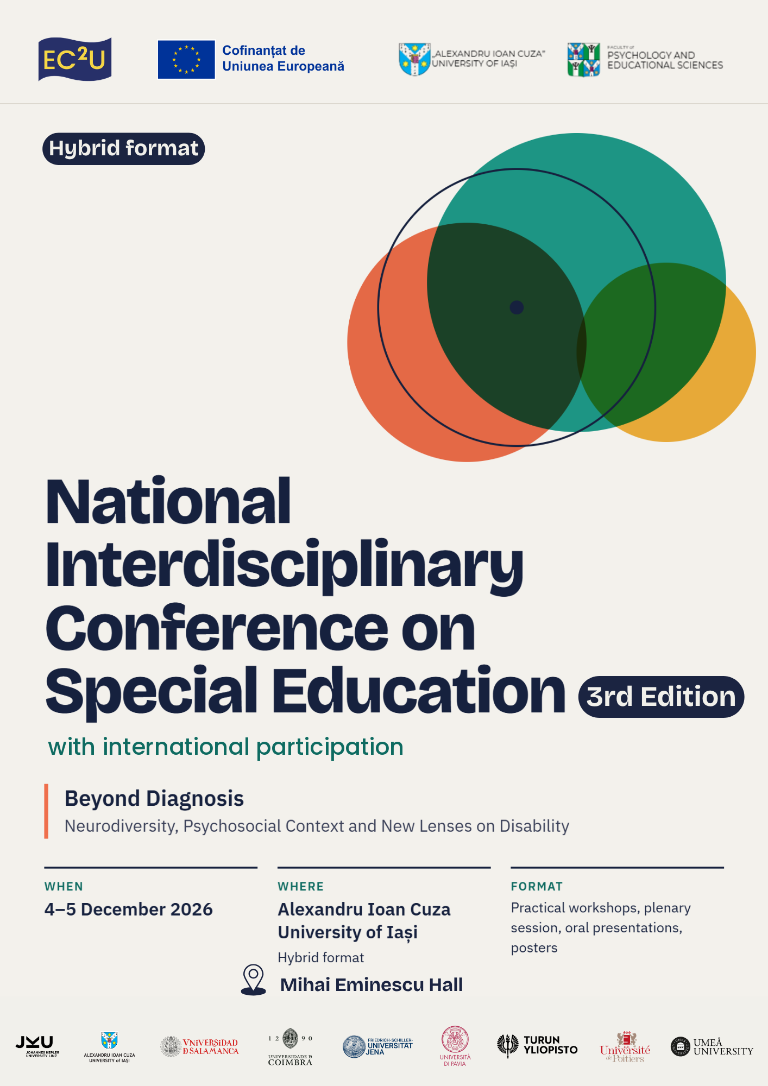
The National Interdisciplinary Conference on Special Education reaches its 3rd edition. It is a scientific event organized by the Faculty of Psychology and Educational Sciences of “Alexandru Ioan Cuza” University of Iași, in collaboration with the universities of the EC2U alliance (European Campus of City-Universities). The conference brings together researchers, teachers from pre-university and higher education, specialists, parents, and representatives of civil society and non-governmental organizations.
The 2026 edition - Beyond Diagnosis: Neurodiversity, Psychosocial Context and the New Lenses of Disability - addresses the life circumstances that can become disabling and the ways in which they limit participation in education and community life. The conference is held in a hybrid format (in person and online), with practical workshops, a plenary session, and oral presentation sessions.
Alexandru Ioan Cuza University of Iași · Faculty of Psychology and Educational Sciences · EC2U - European Campus of City-Universities
The conference is organized around seven core themes, reflecting the shift from a medical to a psychosocial understanding of disability:
Authors are invited to submit papers to one of the following sections:
Autism, ADHD, specific learning disorders and other neurodivergent profiles, from childhood to adulthood; from the deficit paradigm to the difference paradigm
From the medical model to the social and biopsychosocial models; disability as an interaction between the person and their living environment
Divorce, high-conflict separation, bereavement, domestic violence and parental migration - effects on the child's development, learning and mental health
Chronic physical and mental health conditions that limit participation in education and social life, without always being recognized as disability
Poverty, social exclusion, rural isolation and institutionalization - how social contexts produce functional limitations
Individual, family and community resources that enable adaptation in the face of disabling life circumstances
Tools, services and technologies that respond to real functional needs, not just diagnostic labels
The conference is open to everyone who believes that inclusive education is a collective endeavor:
The conference is held in a hybrid format, with in-person attendance in Iași and the option to participate online. The program includes:
14:00–16:00, Room D316, Workshop 1. From diagnosis to functional profile: understanding and supporting the neurodivergent student
Facilitator: Psychologist Rodica Efros
Participants will learn to build a strengths-based functional profile for students with autism, ADHD, or specific learning disorders. Through case studies and group work, they will develop concrete, reasonable classroom accommodations (sensory, organizational and assessment-related) and practice using non-pathologizing language.
16:00–18:00, Room D206, Workshop 2. When the family falls apart: the child in the context of divorce, the loss of a loved one and chronic illness
Facilitator: Assoc. Prof. Oana Dănilă, PhD
The workshop offers a practical tool for identifying psychosocial vulnerability in school and a 3-step support protocol: observation, dialogue with the family, and an individualized support plan. Participants will practice handling difficult situations: communicating with parents in conflict, supporting a student after a loss, and reintegrating a student after long-term hospitalization.
16:00–18:00, Room D316, Workshop 3. Adult ADHD from a neurodiversity perspective: challenges, resources and adaptation
Facilitator: Psychologist Ana Maria Gordita
The workshop “Adult ADHD from a neurodiversity perspective: challenges, resources and adaptation” offers a current, integrated approach to ADHD in adulthood that goes beyond an exclusively deficit-centered perspective. It will discuss specific manifestations, difficulties in everyday functioning and the impact on professional and relational life, as well as the resources, compensatory strategies and strengths associated with neurocognitive diversity. The focus will be on understanding how individual characteristics interact with environmental demands and on identifying adaptation and intervention strategies that support the functioning and autonomy of adults with ADHD.
“Mihai Eminescu” Aula Magna, Building A, UAIC
08.30-9.15 | Participant registration
09:15–9:45 | Conference opening
Plenary lectures - Keynote speakers
9:45–10:15 | Lecture: Prof. Ovidiu Gavrilovici, PhD, UAIC Iași. Well-being. Challenging and contradictory contemporary perspectives.
10:15–10:45 | Lecture: Dr. Laura Chezan, Old Dominion University – Virginia, USA. Implementing evidence-based practices in educational settings
10:45–11:15 | Lecture: Psychologist Alexandra Hasnaș, Association of Recovering Alcoholics (ACAR), Don Orione Residential Center, Romania. Addiction – a disabling condition?
11:15–11:30 | Coffee break and networking
11:30–12:00 | Lecture: Lena Schmitz, EC2U Associate Researcher, University of Jena, Germany. Towards (more) inclusive European higher education institutions: the role of organizational culture in behavioral and structural health promotion interventions
12:00–12:30 | Lecture: Dr. Laura-Elena Runceanu, Jönköping University, School of Education and Communication, Communication, Culture and Diversity Research Group (Sweden). Intersectionality in the context of inclusive education: contributions, dilemmas and challenges
12:30-13:00 | Lecture: Lecturer Alexandra Cobzeanu, PhD, UAIC Iași. The disabling potential of bullying experiences: moral injury and the courage to intervene
13:00–13:15 | Presentation of the EC2U Alliance
13:15–14:00 | Lunch break
14:00–17:00 | Parallel oral presentation sessions (Building D, UAIC)
17:00 | Conclusions and conference closing